Jason was one of my earlier mentoring students, around 2005 if memory serves. He was a VP at one of the largest banks in Hong Kong, in charge of their mainland Chinese relationships. Think big bucks.
Meet “Butterfly”
Although he had a very hectic schedule and flew to China often, Jason was a fairly regular participant in my Trading Room during those years. I nicknamed him Butterfly, affectionately; he was a delightful and very humble fellow. He was always fluttering from one idea to another. When a setup worked a couple of times he would exclaim, “Master, this is the only setup I will ever trade from now on!” When it failed once or twice: “Master, I never trade this setup again!” Charlie reminded us: “Do not draw big conclusions off small data.”
I wrote a long article, Goodman for Butterflies, to help keep him focused and proactive. Expanded somewhat, it became one of my more popular introductory Goodman monographs.
A Quick Trade for a Busy Man
One day he asked me, “Master, I so busy and I move around so much for my position. Do you have a quick setup I can look for and trade? I do not have time for study, do four or five 3-C counts, or seek overlays. Just a quick trade for a few pips when I have a little free time.”
I thought about this for a few days, then decided to wrap Charlie’s Return Point into a quickie trade. In my book The Goodman Playbook I call it the Return Setup, although it is not truly a setup, as that requires use of overlays both inside and outside. I showed the trade to Jason and he was quite pleased. He used it consistently for a time and did OK.
Alas, one day he told me, “Master, I find key to markets! I use Goodman with Ichimoku Cloud charts.”
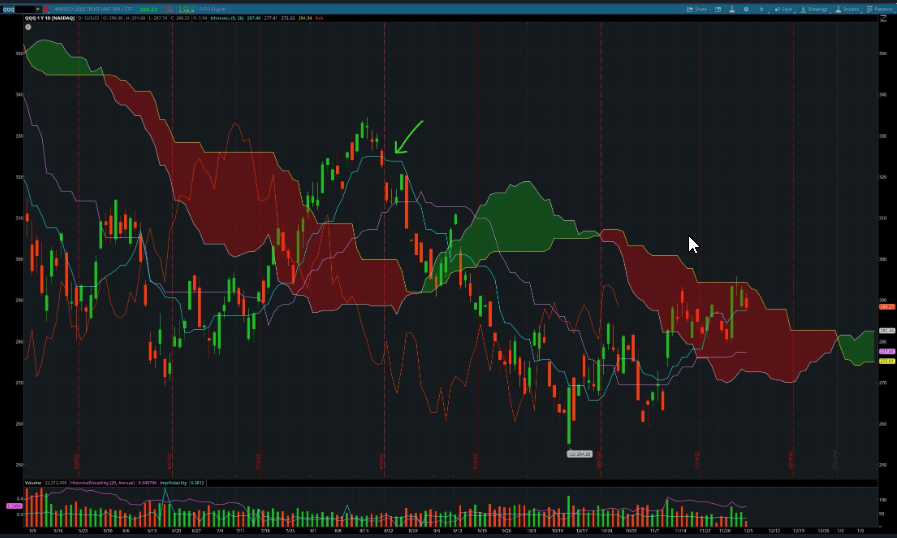
He offered a long and, in my opinion, contorted explanation. I listened attentively and just sort of shook my head. Soon after, new management took over the bank. “A new broom sweeps clean,” and Jason took an early retirement even though he was only in his early 50s. I lost track of him after that.
The Return Point Trade
Jason used it with 2-minute and 5-minute bars. As always with such short-term references, you can only trade the most liquid pairs with low spreads. The profits you seek are quite small, and a large spread can overwhelm the potential profit.

The Return Point in Goodman is the Ending Point (EP) of the Secondary Swing (SS). It acts as a strong magnet as the market attempts to reestablish an equilibrium between buyers and sellers. The rules:
- Given a 1-2-3 Swing or Jumbo, look for a 1-2-3 SS back to the area near the Return Point of the Jumbo.
- This forms a propagated Complex 1-2.
- The SS 1-2-3 SPS EP must be close to a cancel.
- The Jumbo FPS does not need to cancel, but it is sweet if it does.
- Look for a Dagger and enter.
In Goodman terms, you are predicting a Knot to form. Given that both the large FPS and the SS are complex, indicating a robust struggle between buyers and sellers, you are at least playing the odds.
Your S/L is above or below the highest or lowest point of the SS 1-2-3, plus the spread of the pair you are trading. Your T/P is the TP of the SS or 3:1 to your S/L, whichever occurs first.
As always in GWT, the better defined the 1-2-3s, the better. Charlie called this a “clean” chart. Nowadays we call it White Space. If the market moves sideways for two or three bars before a Dagger, essentially testing the high or low, even better.
Extra for experts: If you like the chart in a longer perspective, liquidate one-half of your lot as above and Trade the Line with the other half.
That is it.

Good trading, Butterfly, wherever you are today.
This post is educational commentary. It is not investment advice. Trading futures and FX involves substantial risk of loss.
Good Trading!
Michael Duane Archer
Related Reading
- Open Interest as a Goodman External Overlay: The 8 Rules
- Goodman Molokai Setup: Choosing the Right Time Frame
- Goodmanisms: Charlie Goodman’s Sayings on Trading, Explained
Keep Learning the Goodman Way
If this article was useful, these are the next steps:
- The Method: propagation, intersection and the 3-C Principle, drawn plate by plate.
- The Goodman Library: the books, from Goodman for Grasshoppers to The Goodman 6 & 6.
- The Trader’s Playbook: the Molokai setup in one printed, numbered volume.
- Mentoring: work one-on-one with the authors.