Limited edition · 100 numbered copies
The Goodman Trader’s Playbook
The Molokai setup, in one hundred hands.
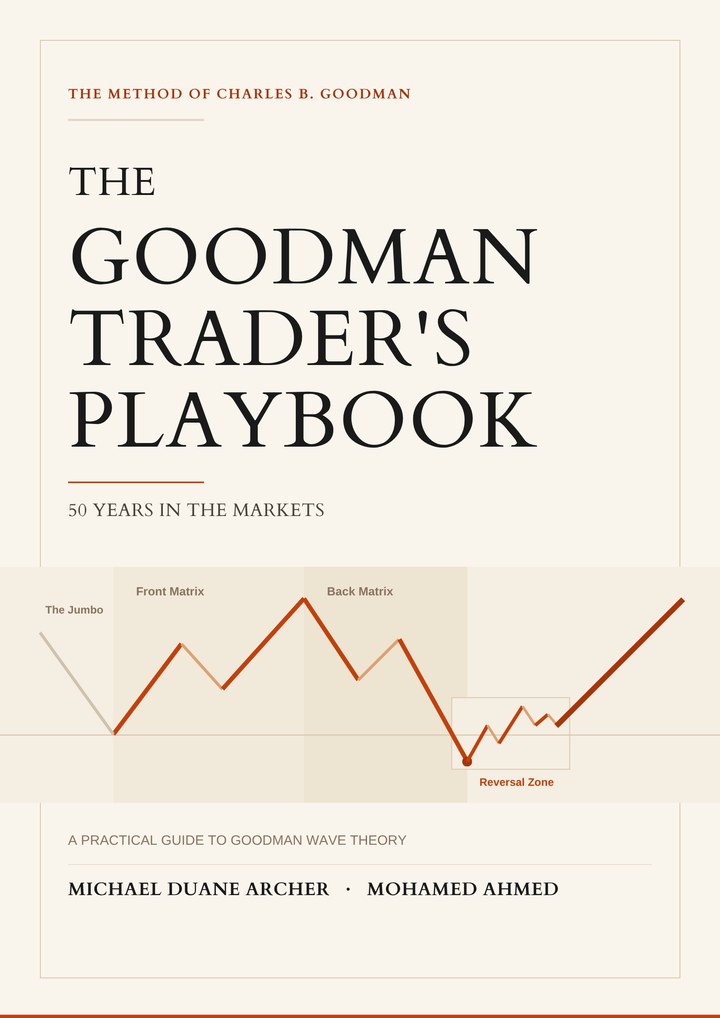
One setup, start to finish, in a printed volume built to sit open beside your screen. Find the Jumbo. Watch a 1-2-3 form at its Ending Point. Watch that 1-2-3 become the first swing of a larger one. Then take the trade the structure has already earned — and close it by rule, not by feel.
Archer’s stated goal in the introduction is to have you trading Goodman in days rather than months. That is possible here only because the book refuses to teach you everything. It teaches one setup, the one Charlie favored, and it teaches it to the end: entry, initial stop-loss, initial take-profit, what to do when the trade runs past the Over count, and the thirty-trade account you use to find out whether you can actually execute it.
Everything the method rests on is in the appendices rather than the main text — the Goodman Wave Theory paradigm, the Principle of Intersection, ParaMatrix — so the chapters stay a procedure you can follow with a chart open.
$5,000
Reserve a copyPrinted · numbered and signed
Why one setup
Archer’s own reasoning, from the introduction: the Molokai is the easiest Goodman setup to identify, its entry, initial stop-loss and initial take-profit are fully mechanical, and in his opinion it is the most reliable of them.
It is the 6 & 6 setup, rechristened. Where the Goldilocks asks for judgment at several points, the Molokai gives you a rule at each one: six swings that must each meet a stated proportion, a Reversal Zone with a measured floor, an entry that waits for a close rather than a touch, and a stop placed off the furthest price traded rather than off a feeling about the market. That is exactly what you want in your second trade, not your two-hundredth.
The trade-off is honest and the book states it: a Molokai needs a close-only stop-loss, where the Goldilocks runs an open one. You give up some immediacy in exchange for not being shaken out by a wick.
“My goal is to get you trading Goodman in days, not weeks or months!”
Michael Duane Archer, Steamboat Springs, November 2025
Molokai territory
The propagated ‘3’ runs past the Jumbo EP and the original ‘1’’s Beginning Point, then closes back inside the body.
What’s inside
- Introduction · As I See It
- How to Find 1-2-3’s
- Setting Up to Trade Goodman
- Find the Jumbo Swing
- Watch for a 1-2-3 to Form
- Watch for the 1-2-3 to become a Larger 1-2-3
- Follow the Propagated ‘2’ Swing
- STOP! The PTS and the Goldilocks Setups
- The Molokai Setup
- Overlays: White Space, Outward Propagation, 3-C Counts
- “The Nest is Best By Test”
- Entering the Trade
- Stop-Loss and Initial Take Profit
- The Line! The Line!
- The 30-Trade Pinch-Penny Account
- The Goodman Method of Trading · The Feedback Loop
- Appendices: The GWT Paradigm · The Principle of Intersection · ParaMatrix
What comes with it
The printed book
Numbered and signed, spiral-bound to lie flat beside a screen. The title page carries your copy number.
The source files
The companion documents referenced in the text: A New Introduction to Goodman Wave Theory, Goodman for Grasshoppers, the 6 & 6 Setup Manual, and Goodmanisms.
A consultation
Sixty minutes online with Archer. Study the book, take notes, then book the call. Questions answered, and a few more Molokai examples shown.
One hundred copies exist and no more will be printed. That is not a marketing device — it is what the colophon says, and the number on your title page is the proof.
Read one for yourself
This is the judgment the book makes mechanical. Decide before you open the answer.
Which bar is the entry?
Price has crossed the Baseline and traded down into the Reversal Zone, stopping short of the floor. Two bars are circled. Which one puts you in the trade, and where does the stop go?
Show the answer
Not the rust bar — that is only the furthest price traded, and it marks the Reversal Point, not an entry. You enter on the bar that closes back inside the body of the propagation. Waiting for that close is the whole discipline of the Molokai: a wick back into the body is not a signal. The stop then sits just beyond the furthest price traded in the Reversal Zone, plus the spread.
The Trader’s Playbook, pp. 97–98 · The Goodman 6 & 6, p. 74
Is this still a Molokai?
The body of the setup measures 100. The Setup Swing has crossed the Baseline and reached 60 below it. Is this a legitimate Molokai, and if the swing had stopped at 40 instead, what would complete it?
Show the answer
At 60 it is busted: the Reversal Zone must not exceed 50% of the body, and when prices go that far you move on. At 40 it is still a candidate — but only a candidate. It becomes a setup when price goes back into the body of the propagation and closes there. Entry is on that close; the stop goes just beyond the furthest price traded in the Reversal Zone, plus the spread.
The Trader’s Playbook, pp. 76–79 (Fig. 95), pp. 97–98 · The Goodman 6 & 6, pp. 50–52, 74
Before you reserve
The Playbook assumes you know your trading platform and nothing else — the appendix supplies the theory. But it sits at the top of the Library ladder for a reason: everything below it makes it land harder. If $5,000 is the wrong first step, start at $97 and come back.
One letter, when there is something to say
Charlie wrote to his students. We do the same: a new plate, a chart worth looking at, a note when a book is finished. No schedule, no sequence, no selling to you every Tuesday. Leave when you like.
We keep the list ourselves. It is never sold, rented or shared.